How I Pre-Qualify Leads Without Making the Enquiry Process Complicated
Generating an enquiry is only the beginning.
Before someone reaches my calendar, I want to understand a few basic things: what kind of business they run, what they’re currently doing, where their enquiries come from, and what happens after a lead comes in.
That doesn’t mean turning the enquiry form into a questionnaire.
The goal is simply to collect enough information to understand whether there may be a fit — while keeping the experience easy for the person completing it.
Here are the fields I use and what each one helps me understand.
Custom HTML/CSS/JAVASCRIPT
Why I Don’t Send Every Enquiry Straight to a Call
It can be tempting to make booking a call the immediate next step for every new enquiry.
But not every enquiry needs the same conversation.
Someone may be at a very early stage. Their business may sit outside the type of work I focus on. They may already be generating plenty of enquiries and actually need better follow-up rather than more traffic.
A small amount of information before the call gives me context.
It also helps the person enquiring get a more relevant conversation if we do decide to speak.
For me, pre-qualification isn’t about putting barriers in front of people.
It’s about creating a clearer next step for both sides.
The Core Fields I Use to Pre-Qualify Every Lead
1. Name: Starting the Relationship Like a Human
I always start simple: Name. It’s basic, but it matters. I use first name in my automated emails and follow-ups so messages feel personal, not robotic. If someone takes a moment to share their name, it signals they’re engaged with the process.
2. Email: The Backbone of Follow-Up
Email is my primary channel for confirmations, reminders, and nurture sequences. I ask for a business email where possible. This makes it easier to:
Send automated reminders before a discovery call
Share a quick pre-call questionnaire or resources
3. Phone: For Time-Sensitive Communication
I keep Phone as a required field, but I’m clear about how I’ll use it: call or text only for booking issues and important follow-up. If email goes missing or ends up in spam, having a second channel helps keep the process smooth for both of us.
4. Business Type: Understanding Alignment Early
This helps me understand whether the business is broadly aligned with the kind of work I do.
My current focus is established service businesses, particularly those already generating enquiries and wanting to improve what happens between enquiry, follow-up and booking.
If there isn’t a fit, it is often better to recognise that before asking someone to spend time on a call.
5. Website: Context Before the Conversation
Asking for a Website URL does two things. First, it lets me confirm that there is an active business behind the enquiry. Second, it gives me context before the call—what they offer, how they position themselves, and how their current digital experience is set up. If there’s no site yet, that usually indicates we may be at an earlier stage and might need to approach the work differently.
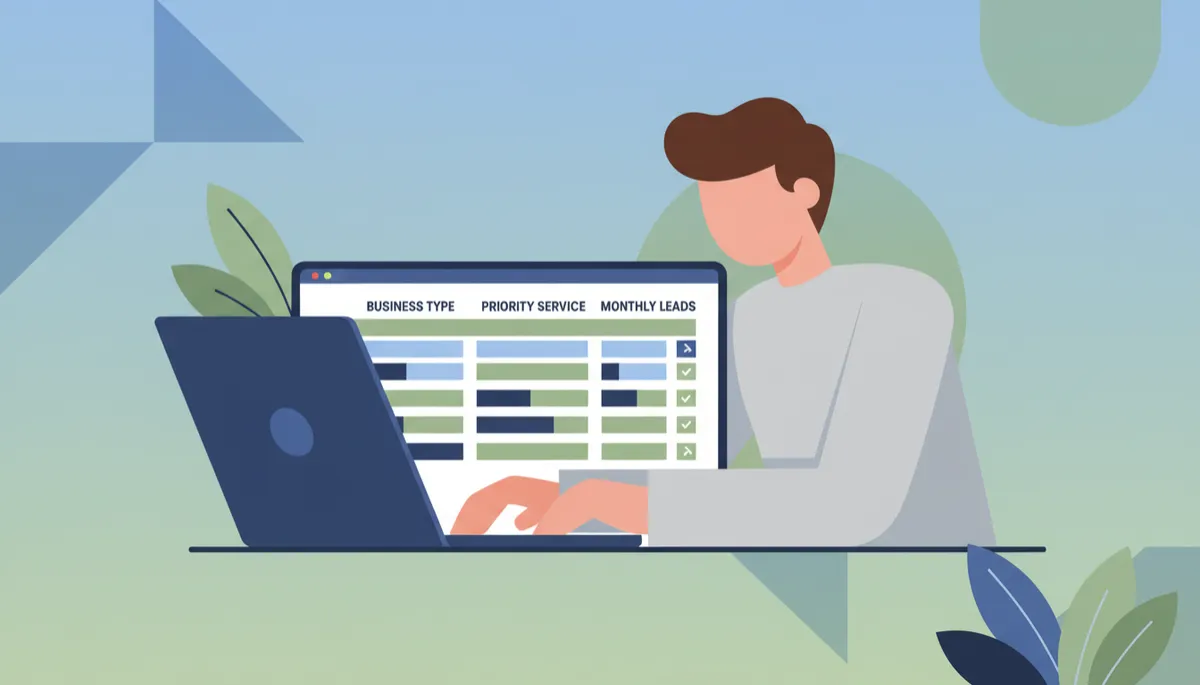
A structured intake form turns messy enquiries into clear, sortable data.
6. What They Want Help With: A Simple Starting Point
Next, I ask what they would like help with. The options are:
Landing pages or funnels
CRM and enquiry management
Follow-up
Booking
Reactivation
Automation
Not sure yet
Business owners don’t need to diagnose the system before talking to me. That is part of the work.
Their answer simply gives me a starting point.
7. Where Their Enquiries Come From: Seeing the Journey in Context
Knowing how a business currently generates interest helps put the rest of the journey into context.
Examples include:
Referrals
Organic search
Paid advertising
Social media
Outbound activity
Other sources
A referral-driven business may have a very different customer journey from one running paid campaigns every week.
The source itself isn’t necessarily good or bad. I’m trying to understand the system around it.
8. Approximate Enquiry Volume: Traffic, Conversion, or Follow-Up
Approximate enquiry volume is where I start to see whether the main challenge is likely to be traffic, conversion, follow-up, or a mix of these. I use simple ranges such as:
Fewer than 20 enquiries per month
20–50
50–100
100+
I don’t need an exact number at this stage.
A simple range is enough to understand whether we’re looking at a traffic problem, a conversion problem, a follow-up problem — or some combination of them.
If a business is already receiving a healthy number of enquiries, generating even more may not be the first priority.
I’d want to understand what happens to the opportunities already coming in.
9. What Happens When Someone Doesn’t Book?
I ask a simple question: “What usually happens when an enquiry doesn’t book immediately?”
The options are:
We don’t have a consistent follow-up process
Someone follows up manually
We have a structured follow-up process
It depends
I’m not sure
This begins to show what happens beyond the initial enquiry.
Someone may be interested without being ready to book today.
If there is no clear next step for those people, that is something worth understanding.
10. Typical Response Time: How the Process Works Day to Day
I also ask how quickly new enquiries are usually acknowledged.
Not because there is one “correct” response time for every business, but because it helps reveal how the current process works.
The options are:
Within an hour
Same day
Within one or two business days
It varies
I’m not sure
If response times vary significantly, the issue may be process or visibility rather than simply needing another marketing channel.
11. Current Follow-Up System: What Already Exists
I also ask: “Do you currently use a system for following up with enquiries?”
The options are:
Yes
Partly
No
Not sure
A “yes” doesn’t automatically mean the system is working well.
And a “no” doesn’t automatically mean the answer is automation.
It simply tells me what already exists before we start discussing what might need to change.
Why I Leave the Deeper Questions for the Conversation
Notice what’s not on my initial form: detailed budgets, long open-ended questions, or anything that feels like homework. That’s intentional. The goal of the form is to screen for fit, not to ask someone to map out their entire business before we speak.
I keep the deeper questions for the conversation, once someone has:
Shown they’re a match on business type and potential service
Demonstrated interest by completing the form
Booked a time on my calendar
On the call, I may ask about revenue, close rates, average customer value, advertising spend, previous campaigns, internal capacity, and the decision-making process. Those questions benefit from context and a real conversation. They don’t need to sit on an initial form.
Instead, I use three guiding questions when I look at a new enquiry:
Is there likely to be a fit?
What part of the customer journey should we look at first?
Would a conversation be useful for both sides?
The Form Is Part of the Customer Journey
The biggest shift for me was to stop thinking of an enquiry form as a place to collect contact details.
It is part of the customer journey.
Every field should have a reason for being there.
Too little information and you may reach the conversation without enough context.
Too much information and the form starts to feel like work.
The aim is somewhere in between: enough information to understand the situation, while keeping the next step simple.
That is how I approach pre-qualification in my own funnel at Growth Engine AI.
Not as a way to keep people out — but as a way to create a better conversation when there is a genuine fit.
Strategy first. Technology second.
Not sure what happens to your enquiries after they come in?
The Growth Leak Audit looks at the journey from enquiry through response, follow-up and booking, so you can see where the process may need attention.
Get Your Growth Leak Audit →